WG3. Comparative country analysis and best practices identification – Scientific
Task T3.1: Review and analysis of state-of-the-art.
Task T3.2: Selection of a set of countries and units of analysis that can be compared (this depends on the collected data at the country level, and its comparability), and discussion of the main issues that can be addressed with the comparable data, and identification of the issues that could be covered.
Task T3.3: Measurement of efficiency of the circular economy for the selected countries conditional on national socio-economic conditions, using non parametric (nonparametric conditional frontiers) and parametric (meta-frontiers) methods.
Task T3.4: Identification of main sources of inefficiency when similar units are compared between countries and identification of best practices at the country’s level and counterfactual analysis to estimate impact of implementing reforms.
Task T3.5: Assessing the environmental benefits and consumer protection of different circularity strategies for several scenarios and identifying best practices based on the lowest potential environmental impact.
All these tasks will contribute to developing innovative methods to apply consumer education strategies for a circular economy and will identify best practices for other countries. Furthermore, this WG aims to create integrated solutions for countries based on linear economy buildings which will answer to circularity challenges of resource efficiency and waste prevention through reducing, reusing, repairing.
DESCRIPTION OF DELIVERABLES AND TIMEFRAME
WG3. Comparison (between Q6 – Q12)
– Milestones M3: Identify conditions of comparability of responsible institutions for circular economy
strategy across Europe (what institutions can be compared and within which countries); M4 Identifying
sources of inefficiency towards best practices across European countries, potential benefits and costs
that could follow their introduction.
– Deliverables:
D2. One (1) State-of-the-art report/Intermediate scientific reports (working papers) to circulate in the
scientific community;
D4. One (1) Circular design strategy for consumer protection and best practices
D5 One (1) Technical report to be shared with stakeholders on Comparative country analysis and best
practices identification
D7 One (1) Scientific publication;
D9. One (1) Newsletter;
D10 One (1) Webpage (common for all WGs) with main results from the analytical stage of the project.
-Activities:
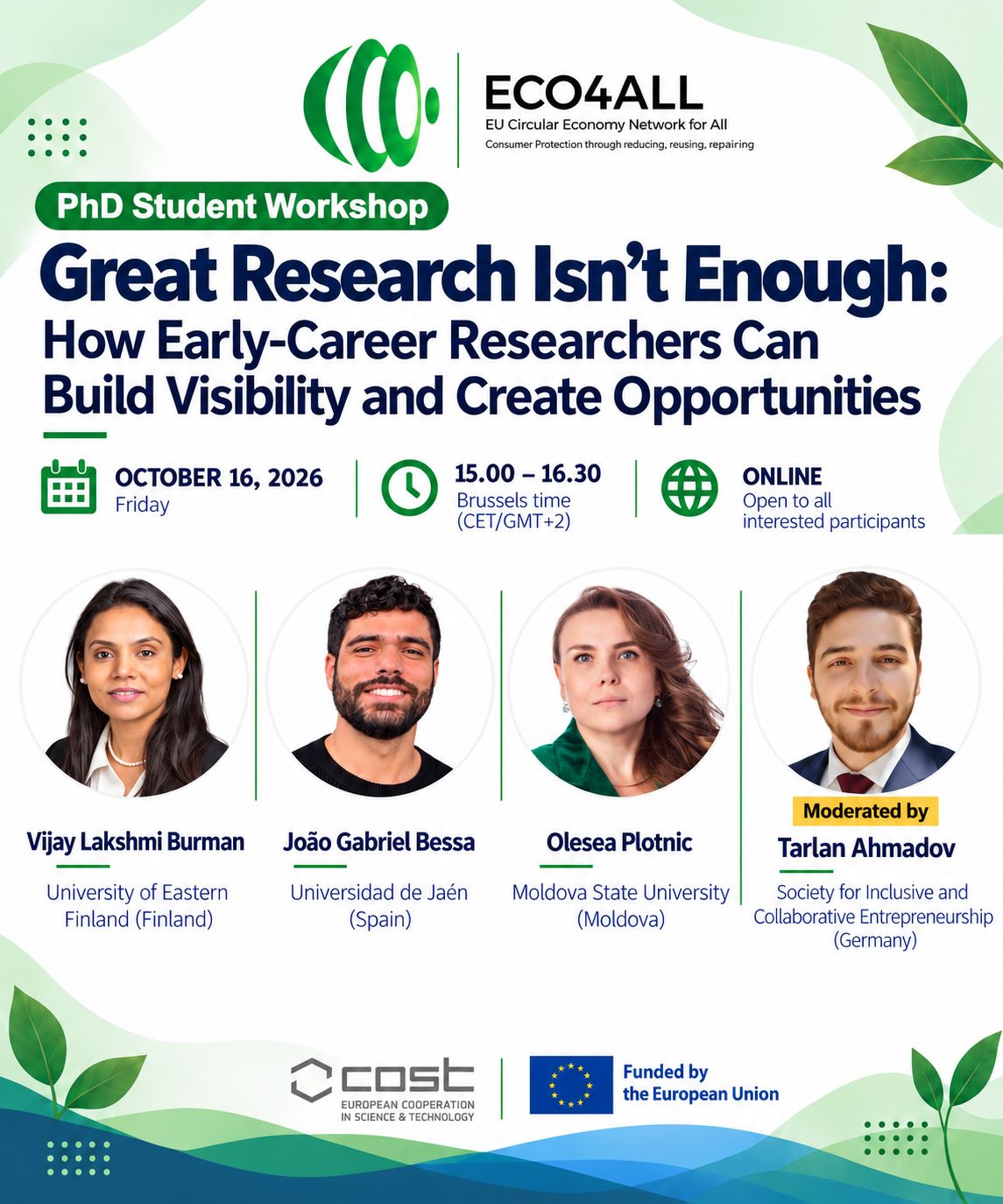
A1 Workshop II for Ph.D. students;
A2. Training Schools;
A3. STSMs;
A4. Scientific publications and research papers.